


Ultra-low limits of detection for glucose and uric acid using 3D silver nanostructures decorated with bimetallic (AgAu) nanoparticles as SERS sensors

Abstract
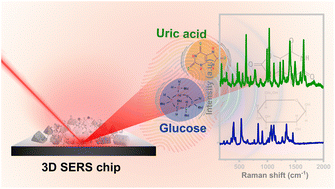
This study reports an ultra-sensitive, surface engineered, three-dimensional nanostructured Surface-Enhanced Raman Spectroscopy (3D SERS) platform for the label-free detection of glucose and uric acid at picomolar concentrations and aromatic dye molecules up to femtomolar concentrations. This sensor integrates bimetallic AgAu nanoparticles into silver (Ag) nanostructures on a silicon (Si) substrate with precision UV laser scribing. A 3D SERS sensor of high sensitivity and stability is achieved through a synergistic approach combining bimetallic nanoparticles produced by laser ablation in liquid and laser patterning for nano-structuring of Ag layers on a Si substrate immersed in this nanocolloid, yielding an architecturally configured surface with high-density plasmonic hotspots. The homogeneous distribution, structural and morphological investigations, and the chemical purity of the synthesized nanostructures are analyzed using advanced characterization studies. The sensor achieves an analytical enhancement factor (AEF) of 1.26 × 10¹¹ for a Raman reporter molecule (R6G), with resolvable spectral features for glucose and uric acid down to 10−12 M (1 pM), thereby emphasizing its exceptional detection limit, surpassing the detection limits of most of the analytical techniques reported in the literature. The sensor exhibits outstanding spectral reproducibility (RSD = 5.56% for 1 nM of uric acid), robust linearity across six orders of magnitude (R2 = 0.98) and remarkable temporal stability, maintaining signal fidelity for over 10 weeks under ambient conditions. The capability of multiplexed analyte identification is demonstrated through co-detection of glucose and uric acid at 1 pM. The facile fabrication, architectural scalability, and long-term operational stability position this 3D SERS sensor as a formidable candidate for next-generation, portable diagnostic platforms for bioanalytical applications.
 Please wait while we load your content...


