


The role of molecular ambient adsorption on light–matter interactions of 2D few-layered ReSe2 photodiodes

Abstract
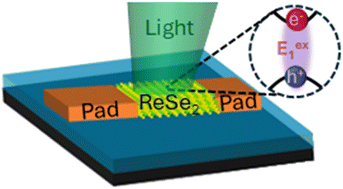
Photodiodes and transistors are key building blocks of optoelectronic devices. Two-dimensional rhenium diselenide (ReSe2) offers new prospects in such devices due to its moderate and direct bandgap. We show here that ambient conditions, specifically the interactions with oxygen atoms, play an instrumental role in enhancing the conductivity of positive charge carriers (holes) and photoconductivity in ReSe2. We characterized the electrical and optoelectrical responses of few-layered ReSe2 and ReSe2/hexagonal boron-nitride (hBN) heterostructures under different conditions of gating and illumination. We show that while the hBN encapsulation did not change the excitonic nature and atomic bonds of the ReSe2, it prevented its exposure to ambient oxygen, and as a result, dramatically deteriorated its conductivity, as the carrier mobility was reduced by two orders of magnitude. ReSe2 photodetectors that were exposed to the ambient atmosphere, on the other hand, experienced a gating-like effect and presented excellent performances with high currents (hundreds of nano-amps), responsivity (reaching ∼100 A W−1), detectivity, and external quantum efficiency (EQE, up to ∼104%). Therefore, we shed light on the fundamentals of the light–matter interactions of ReSe2 and demonstrate its ability to operate as a high-end electronic and optoelectronic component.
 Please wait while we load your content...


