


High thermoelectric figure of merit in nonplanar graphene nanoribbons with periodic divacancies
 *b
and
Qunxiang
Li
*b
*b
and
Qunxiang
Li
*b
Abstract
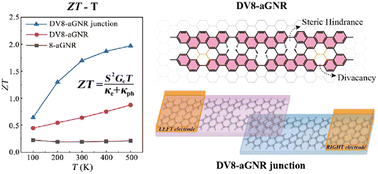
Design and implementation of high-performance thermoelectric (TE) devices pose significant challenges from both theoretical and experimental perspectives. Utilizing experimentally synthesized eight-carbon-wide armchair graphene nanoribbons with built-in periodic divacancies (DV8-aGNR), we address these challenges with three effective strategies: periodic pores, nonplanarity, and vertical junctions, all with the goal of minimizing phonon thermal conductivity and achieving a high figure of merit (ZT). Through first-principles calculations, we firstly investigate the TE performance of DV8-aGNR, which reveals that the periodic divacancies and nonplanar characteristics can effectively reduce phonon thermal conductivity while enhancing electrical conductance. A maximum ZT value of 0.64 at room temperature and 0.87 at 500 K in DV8-aGNR is 337% and 414% times that of the armchair graphene nanoribbon with the same width. Then the proposed van der Waals junction further restricts phonon transmission and exhibits improved TE properties, with ZT values rising to 1.70 and 1.97 at 300 and 500 K, respectively. The enhancement of ZT observed in DV8-aGNR and its vertical junction underscores the potential of our strategies for developing carbon-based TE devices with high performance.
 Please wait while we load your content...


