



Fixed node-diffusion Monte Carlo achieves chemical accuracy in predicting substituent effects on activation energies and reaction enthalpies for methyl radical addition to substituted olefins
 *a
and
Ralph A.
Wheeler
*a
*a
and
Ralph A.
Wheeler
*a
Abstract
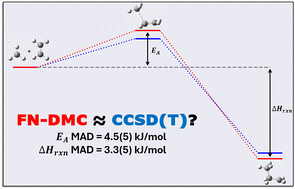
Computing accurate activation barriers and reaction enthalpies is essential for the development of kinetic mechanisms and prediction of reaction outcomes. However, the computationally intensive nature of accurate quantum calculations and lack of experimental data present challenges. In this study, eighteen radical addition reactions relevant to free radical polymerization were used to assess the accuracy of single-determinant fixed-node diffusion Monte Carlo (FN-DMC) in predicting activation barriers and reaction enthalpies. Using CCSD(T)/aug-cc-pVTZ as a reference, FN-DMC acquired a mean absolute deviation (MAD) of 4.5(5) kJ mol−1 for activation energies and 3.3(5) kJ mol−1 for reaction enthalpies. Activation energies and reaction enthalpies relative to the unsubstituted olefin exhibited relative MAD values of 1 kJ mol−1 and accurately predicted trends in substituent effects within statistical margins, except for the activation energies of the butanenitrile and 2-methoxybutyl radical systems and the reaction enthalpies of the ethoxypropyl and butyl analogs. With the demonstrated accuracy, favorable computational scaling, and highly parallelizable nature of FN-DMC, it should be feasible to use FN-DMC to investigate activation energies and reaction enthalpies for larger systems, such as oligomers, where coupled-cluster based methods may be limited by computational resources.
 Please wait while we load your content...


