


Unlocking enhanced electrochemical performance through oxygen–nitrogen dual functionalization of iron–nickel–sulfide for efficient energy storage systems†

Abstract
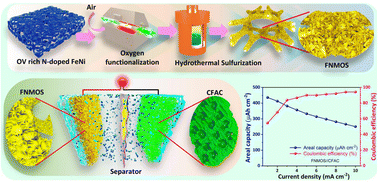
Developing an energy storage electrocatalyst that excels in efficiency, cost-effectiveness, and long-term stability over numerous charge–discharge cycles is paramount for advancing energy storage technologies. In this work, we present a simple and environmentally friendly method to fabricate an asymmetric supercapacitor device (ASCD) as a viable energy storage system. The ASCD features binder-free, oxygen–nitrogen dual functionalized, and sulfurized iron–nickel hydroxysulfide (FNMOS) electrocatalysts, self-grown on nickel foam as a positive electrode, and waste biomass-derived activated carbon (CFAC) as a negative electrode. The FNMOS electrode in a 3-electrode configuration has the highest area-specific capacity of 1.6 mA h cm−2 at 1 mA cm−2, and even at a high current density of 10 mA cm−2, it maintained 0.94 mA h cm−2. The enhanced electrocatalytic activity is due to the synergistic contribution of the sulfurized NiFe composite along with the meticulous oxygen–nitrogen co-functionalization. Additionally, the ASCD with the FNMOS positive electrode and the CFAC negative electrode achieves maximum energy density (ED) and power density (PD) values of 350 μW h cm−2 (825 μW per cm2 PD) and 7960 μW cm−2 (200 μW h per cm2 ED). Furthermore, the device demonstrated exceptional rate capability by maintaining over 96% of its initial capacity even after 25 000 cycles of charge and discharge. The exceptional stability was further characterized by the ex situ post-mortem analysis of the FNMOS electrode after the stability test. These encouraging electrochemical results, paired with some practical use cases, demonstrate the applicability of FNMOS as a next-generation energy storage material.
- This article is part of the themed collection: Nanomaterials for a sustainable future: From materials to devices and systems
 Please wait while we load your content...


