


Recent advances in glutarimide chemistry for cereblon-mediated targeted protein degradation: developments in synthesis and diversification

Abstract
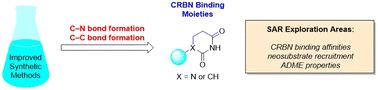
The field of targeted protein degradation has garnered significant attention over the past two decades, highlighted by the FDA approval of several therapeutics and the entry of numerous drug candidates into clinical development, the majority of which are cereblon (CRBN) based therapeutics. Synthetic strategies to access these modalities have evolved from low-yield, multi-step syntheses to more efficient methodologies emphasizing late-stage and/or one-step functionalization. In this review, we discuss 22 recently published literature studies focusing on synthetic methodologies compatible with glutarimide scaffolds, which serve as key cereblon-binding ligand for E3 ubiquitin ligase recruitment. The methodologies covered include modern one-electron transformations such as metal-catalyzed reductive couplings, decarboxylative cross-electrophile couplings, and electro/photocatalytic couplings. In addition, we highlight optimized two-electron transformations including Buchwald–Hartwig, Suzuki–Miyaura and Sonogashira couplings that tailored for glutarimide-containing substrates. Novel synthetic approaches, such as N–H insertion, click chemistry, C–H functionalization, and carbene-mediated cyclopropanation/cyclopropenation, are also discussed for their potential in enabling the rapid development of novel cereblon-mediated degraders.
 Please wait while we load your content...


