


 PLATFORM UPDATE:


Leaf-inspired graphene/MnO networks encapsulating Co nanoparticles through micro–nano-structural engineering for enhanced photo-stimulated rechargeable Zn–air batteries
 *a
Daqiang
Gao
*c
*a
Daqiang
Gao
*c
Abstract
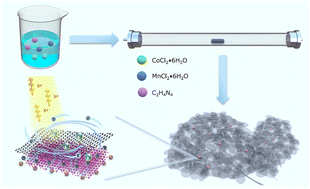
Harnessing solar energy to modulate light absorption ability and carrier separation efficiency is a highly promising strategy for enhancing oxygen photoelectrocatalytic reactions; however, it poses significant challenges. In this study, inspired by the network and structural properties of natural leaves, a leaf-like topological network is engineered via a micro–nano-structure design. A MnO/Co heterojunction is anchored on the network, exhibiting strong interfacial coupling that promotes electron–hole separation, subsequently exhibiting improved photoelectrocatalytic performance. Consequently, the MnO/Co@N–C catalyst achieves an oxygen evolution reaction (OER) overpotential of 1.42 V at a current density of 10 mA cm−2 under illumination, which is significantly lower than the 1.52 V obtained under dark conditions. Furthermore, a Zn–air battery (ZAB) with a MnO/Co@N–C air cathode demonstrates a power density of 189 mW cm−2 under illumination, which is 33.1% higher than that without illumination. Remarkably, the round-trip efficiency of the MnO/Co@N–C-based ZAB increases from 55.6% to 64.1% under illumination, while its cycling stability increases by approximately 66.7% from 150 h to 250 h. Density-functional theory calculations and multiple photonic spectroscopy analyses demonstrate that the synergistic interactions between MnO and Co significantly enhance the electron transfer rate and electron–hole separation, thus promoting excellent catalytic activity. The findings of this study open a new avenue for enhancing OER/oxygen reduction reaction (ORR) bifunctional electrocatalysis and present an effective strategy for improving the efficiency of ZABs.
 Please wait while we load your content...


