


In situ doped cobalt sub-nanometer clusters in hierarchically porous carbon for enhanced oxygen reduction reaction performance

Abstract
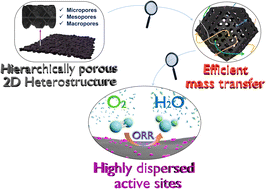
Hollow turtle shell-like mesoporous carbon (HTMC) materials were designed with embedded Co sub-nanometer clusters (SNCs) via a multistep template-mediated synthesis. In this method, graphene oxide (GO) was first used as a two-dimensional (2D) non-sacrificial template to allow in situ growth of bimetallic (Co and Zn) zeolitic imidazolate framework (ZIF) heterostructures. By varying the feed ratio of Co and Zn, ZIFs of different bimetallic composition were grown on the surface of GO. The ZIFs then act as sacrificial templates to produce well-defined hollow cavities (i.e., macropores) during a subsequent mesostructured polydopamine coating step. Upon carbonization at 900 °C under N2 atmosphere, hierarchically porous 2D carbons loaded with Co species were obtained and termed CoHTMC-x (where x refers to feed% of Co). It was found that the materials synthesized with a Co feed ratio of 2.5% reached a critical point at which Co nanoparticles (NPs) are formed during thermal treatment, and therefore CoHTMC-x materials synthesized with a Co feed ratio less than 2.5% were chosen for in-depth investigation. Specifically, this work focuses on analyzing a series of four materials of almost identical carbon support morphology but with varying Co content, namely, HTMC (no Co), CoHTMC-0.5, CoHTMC-1.0, and CoHTMC-1.6. Electrochemical measurements in 0.1 M KOH established CoHTMC-1.0 as the optimum oxygen reduction reaction (ORR) electrocatalyst in the series, balancing fine dispersion and high density of Co active sites on the carbon surfaces. CoHTMC-1.0 exhibited the best performance among the materials in the series in multiple key metrics, with an onset potential (Eonset) of 0.865 V vs. the reversible hydrogen electrode (RHE), a half-wave potential (E1/2) of 0.786 V vs. RHE, an electron transfer number (n) of 3.81, a H2O2 yield of 9.31%, a kinetic current density (jk) of 20.74 mA cm−2 at 0.5 V vs. RHE, and an electrochemically active surface area (ECSA) of 11.75 mF cm−2. Herein, we demonstrate a highly resource-efficient and adaptable method for the synthesis of high-performing electrocatalysts without the use of costly platinum-group metals (PGMs).
 Please wait while we load your content...


