


 PLATFORM UPDATE:

Aerobic biotransformation of a novel highly functionalized polyfluoroether-based surfactant using activated sludge from a wastewater treatment plant†
 *a
and
*a
and
Abstract
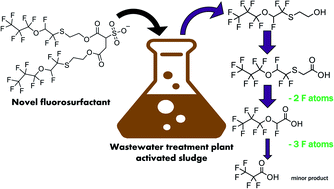
A replacement fluorosurfactant has been recently introduced to the European market as an alternative to other per- and polyfluoroalkyl substances (PFAS) that have been phased-out or banned. Here, we incubated this novel fluorosurfactant (diFESOS, [F7C3OCHFCF2SCH2CH2OC(O)]2C2H3SO3−) which contains ether and thioether insertions, and its known polyfluoroalkyl degradation products, an alcohol (FESOH) and carboxylic acid (FESCA), with activated sludge from a wastewater treatment plant under sulfur-limited conditions. Dosed chemicals and their transformation products were monitored using ultra-high performance liquid chromatography-tandem mass spectrometry, and gas chromatography-mass spectrometry. In addition to FESOH and FESCA, two smaller metabolites were identified: C3F7OCHFCOO− (2H-3:2 PFECA) and perfluoropropanoic acid (PFPrA). 2H-3:2 PFECA presumably was a result of S-dealkylation of FESCA, which then resulted in the abiotic cleavage of two C–F bonds; no S-oxygenation was observed. Overall, the terminal products of this biotransformation likely have lower bioaccumulation potential than the parent fluorosurfactant based on comparison to other similar PFAS.
 Please wait while we load your content...


