


Toward a mechanistic understanding of bioluminescence: a theoretical study of furimazine oxidation and luminescence

Abstract
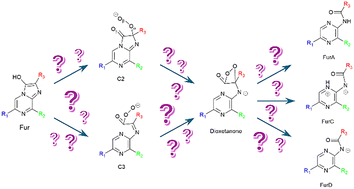
The desirable attributes of luciferin–luciferase systems for bioluminescence imaging include their high luminescence intensities, minimal background signals, and compact enzyme sizes, with robust structural stability under experimental conditions. The NanoLuc–furimazine system has emerged as a promising candidate, fulfilling all these requirements. However, the detailed reaction mechanism leading to furimazine oxidation and the nature of the luminescent species remain largely unknown. Current understanding is limited to the formation of an excited-state product as a consequence of furimazine oxidation. In this context, this study exploits density functional theory and its time-dependent formalism to identify reactive species and analyze the possible mechanisms associated with this process in a solution, including the investigation of two possible oxygenation pathways and the formation of subsequent excited-state furimamide. For completeness, three different protonation states of furimamide were considered, and its zwitterionic form emerged as a promising candidate for emission applications, offering new insights and establishing a foundation for the future extension of this study in a protein environment.
 Please wait while we load your content...


