


Novel compositional-gradient hierarchical ZnS/GeS2 heterojunction nanorods for high-rate and durable sodium storage
 *a
Liang
Cao
*b
*a
Liang
Cao
*b
Abstract
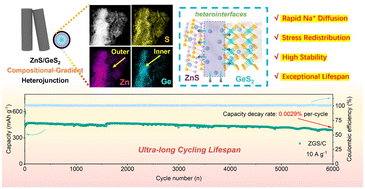
Transition metal sulfides (TMSs) are attractive anode materials for sodium-ion batteries because of their high theoretical capacities and reversible conversion chemistry. However, the sluggish charge transfer and large volume changes of TMSs during repeated Na+ insertion and extraction result in inferior rate capability and cycle life, hindering their practical applications. Herein, we report a controllable interdiffusion and vulcanization method for designing hierarchical composition-gradient ZnS/GeS2/C heterojunction nanorods from Zn2GeO4 precursors. During high-temperature sulfidation, the mutual diffusion of differential elements forms a ZnS-rich shell and a GeS2-rich core, thereby generating abundant ZnS/GeS2 heterointerfaces within a conductive carbon matrix. The in situ formed heterointerfaces between ZnS and GeS2 facilitate interfacial electronic and ionic transport, while the composition gradient interacts with the carbon network to redistribute mechanical stress and mitigate fragmentation of active material upon long-term cycling. As a result, the prepared ZGS/C anode delivers a reversible capacity of 663.6 mAh g−1 at 1.0 A g−1 and retains 389.6 mAh g−1 after 6000 cycles at 10 A g−1. Additionally, the full cell with a Na3V2(PO4)3 cathode exhibits an initial reversible capacity of 347.8 mAh g−1 at 0.5 A g−1, with a capacity retention ratio of 77.6% after 200 cycles. The work on the interdiffusion and vulcanization approach provides scalable strategies for heterointerface engineering of multicomponent sulfide anodes.
 Please wait while we load your content...


