Design and evaluation of an HSP70-targeting PROTAC in synergy with an HSF1 inhibitor for enhanced antitumor activity

Abstract

Heat shock protein (HSP) 70 represents a clinically promising anti-tumor target, yet the development of effective inhibitors faces numerous technical challenges. To address this, we developed novel non-ATP site Proteolysis-targeting Chimeras (PROTACs) that selectively degrade HSP70 by engaging the E3 ubiquitin ligase CRBN. However, the PROTACs exhibited limited degradation activity, potentially due to heat shock response-mediated HSP70 upregulation. To circumvent this resistance mechanism, we explored combination therapy with the heat shock factor 1 (HSF1) inhibitor DTHIB to disrupt the heat shock feedback loop, markedly enhancing HSP70 degradation. The combination strategy showed synergistic and selective anti-tumor activity across a panel of cancer cell lines. This success relied on the distinct profile of C4, which preferentially targets cytosolic HSP70 and, unlike conventional inhibitors, effectively circumvents compensatory HSP70 upregulation.
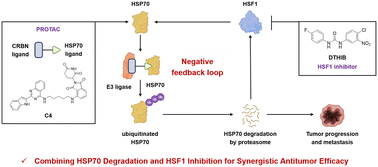
Graphical abstract: Design and evaluation of an HSP70-targeting PROTAC in synergy with an HSF1 inhibitor for enhanced antitumor activity

Supplementary files

Article information

Article type
Research Article
Submitted
19 Aug 2025
Accepted
29 Oct 2025
First published
18 Nov 2025

RSC Med. Chem., 2026, Advance Article

Design and evaluation of an HSP70-targeting PROTAC in synergy with an HSF1 inhibitor for enhanced antitumor activity

W. Huang, T. Mao, G. Dai, J. Ye, J. Li, S. Chen, J. Tan, Z. Huang and S. Huang, RSC Med. Chem., 2026, Advance Article , DOI: 10.1039/D5MD00726G

To request permission to reproduce material from this article, please go to the Copyright Clearance Center request page.

If you are an author contributing to an RSC publication, you do not need to request permission provided correct acknowledgement is given.

If you are the author of this article, you do not need to request permission to reproduce figures and diagrams provided correct acknowledgement is given. If you want to reproduce the whole article in a third-party publication (excluding your thesis/dissertation for which permission is not required) please go to the Copyright Clearance Center request page.

Read more about how to correctly acknowledge RSC content.

Social activity

Spotlight

Advertisements