


Hyperproduction of 3-hydroxybutyrate using engineered probiotic E. coli Nissle 1917 from glucose and CO2-derived acetate

Abstract
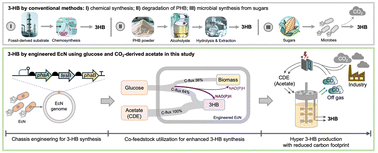
Escherichia coli Nissle 1917 (EcN), an endotoxin-free probiotic, has been engineered for diverse medical treatment uses with extensive studies. However, engineering EcN as a chassis to synthesize different value-added products like food additives is also a promising direction that is generating increasing interest. Herein, EcN was engineered to achieve sufficient synthesis of 3-hydroxybutyrate (3-HB), a rising-star compound showing promising applications in food, healthcare and medical treatment, to address the state-of-the-art challenges such as low production yield and high cost. Firstly, the key synthesis pathways converting acetyl-CoA to 3-HB encoded by phaA, phaB and tesB genes were constructed, screened and fine-tuned in recombinant EcN to achieve prototype 3-HB synthesis from glucose with the production titer increased by over 23%. Secondly, glucose and acetate at a well-designed ratio were co-fed to boost the synthesis of 3-HB with the titer and molar carbon conversion rate reaching 28 g L−1 and 75.6 mol%, respectively, in a shake flask study using optimized M9 medium. Finally, a fed-batch study of 3-HB production using chromosomally engineered EcN, namely EY15, was conducted in a 7 L bioreactor, yielding 105 g L−1 3-HB at an 85.6 mol% carbon conversion rate after 52 h of cultivation. Furthermore, a 90 g L−1 3-HB yield and 82.6 mol% carbon conversion rate were obtained under the same fed-batch conditions except for using glucose and CO2-derived acetate as co-substrates. Moreover, the life cycle assessment (LCA) of 3-HB from mixed carbon sources showed over 70% reduction of environmental impacts compared to using glucose only. This work not only provides a solution for high-level 3-HB production with outstanding atom economy but also demonstrates the strong potential of the probiotic chassis EcN for high-yield product synthesis with a reduced carbon footprint.
 Please wait while we load your content...


