


Metal–organic frameworks for the adsorption of alkali metal ions

Abstract
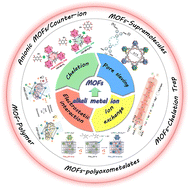
Highly efficient separation and recovery of alkali metal ions (e.g. lithium, sodium, potassium, rubidium, and cesium) from natural and artificial brines are urgent tasks because of the huge reserves of brines and their increasing demand in advanced industries. During the past twenty years, porous metal–organic frameworks (MOFs), with controllable channel structures and chemical micro-environments, have been exploited as new choices in the field of alkali metal ion adsorption and separation. This review focuses on the progress in MOFs and MOF-based adsorbents for the selective capture and co-adsorption of alkali metal ions. The adsorption performances of various MOFs were rationally assessed and compared based on their adsorption capacity, kinetics, selectivity, and regeneration. The mechanisms, including chelation, ion exchange, pore sieving, and electrostatic interaction, were systematically summarized from the perspectives of adsorption thermodynamics and diffusion dynamics. Finally, the current drawbacks and challenges were highlighted and future opportunities were proposed for designing highly efficient MOF-based adsorbents for the adsorption of alkali metal ions.
 Please wait while we load your content...


