


 PLATFORM UPDATE:


A regenerable redox mediator for all-air processed wide-bandgap perovskite solar cells under high-humidity conditions
 b
and
Xiao-Feng
Wang
*a
b
and
Xiao-Feng
Wang
*a
Abstract
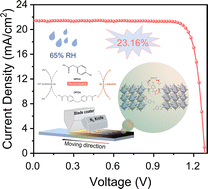
The commercialization of wide-bandgap (WBG) perovskite solar cells (PSCs) faces critical challenges in high-humidity fabrication environments and long-term operational stability. To address these issues, this study introduced 4-mercaptophenylacetic acid (MPAA) as a redox mediator into the perovskite. MPAA facilitates cyclic regeneration through the reversible conversion of thiol-disulfide, simultaneously reducing I2 and oxidizing Pb0, thereby effectively suppressing phase separation. Furthermore, its benzene ring's hydrophobic structure forms moisture barrier, significantly improving the fabrication adaptability of the perovskite in a high-humidity environment. Benefiting from these characteristics, the device fabricated by blade coating in high-humidity ambient air (≈65% relative humidity, RH) achieves a power conversion efficiency (PCE) of 23.16%, which is the state-of-the-art result for the WBG (≥1.68 eV) PSCs fabricated in ambient air. The fabricated mini-module (13 cm2) achieves a PCE of 18.46%, demonstrating the scaling potential of this strategy. Meanwhile, the MPAA-doped device retained 90.2% of its initial PCE after aging for 500 hours under the ISOS-L-3 protocol (85 °C, 50% RH), while the control device exhibited almost complete degradation. This strategy overcomes the limitations of high-humidity fabrication and long-term operational stability problems of WBG PSCs, thus providing significant support for the industrialization of perovskite photovoltaics.
 Please wait while we load your content...


