


 PLATFORM UPDATE:


A Cu+-doped zinc organic halide with temperature-dependent dual-color emission as a thermochromic molecular thermometer

Abstract
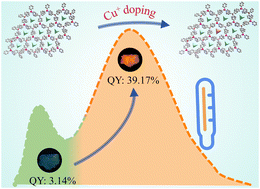
Zero-dimensional (0D) zinc halides have attracted intensive attention in multiple optoelectronic fields due to their excellent stability. However, most Zn-based halides show relatively weak luminescence efficiency, which limits their further widespread application. Herein, we successfully optimize the electronic structure of a new 0D Zn halide, [MTPP]2ZnBr4 ([MTPP]Br = methyltriphenylphosphonium bromide), via a Cu+ doping strategy to realize highly efficient and adjustable dual-color emission. Compared with the weak blue-green emission of undoped [MTPP]2ZnBr4, the incorporation of Cu+ ions results in the emergence of a new intense orange emission at 630 nm with a highest photoluminescence quantum yield (PLQY) of 39.17%. More significantly, the relative intensities of the dual emission feature transform depending on the environmental temperature due to the thermally associated reversible energy transfer between each self-trapped excitonic (STE) state, which enables this doped phase to act as a promising luminescent ratiometric thermometer with a relative thermal sensitivity of 0.94% K−1 in the range of 80–260 K. Furthermore, this phenomenon also enables the material to achieve tunable multicolor luminescence with advanced applications in anti-counterfeiting. This study realizes highly efficient dual-color emission in a Zn-based halide and temperature-dependent thermochromic luminescence with wide applications in temperature monitoring and anti-counterfeiting.
 Please wait while we load your content...


