



Self-assembling peptides construct supramolecular materials
 *abcd
*abcd
Abstract
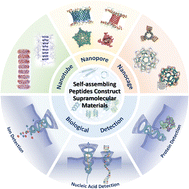
Programmable peptide self-assembly enables the precise construction of supramolecular materials, establishing it as a defining frontier in nanomaterials research. This review systematically explores the collective contribution of sequence design, secondary structure regulation (including α-helices, β-sheets, and cyclic conformations), and dynamic modulation, and hierarchical organization in facilitating the creation of well-defined nanostructures such as nanotubes, nanopores, and nanocages. Artificial intelligence and computational modeling have emerged as critical tools to guide peptide design and predict assembly pathways, thereby enabling a strategic shift from empirical screening to mechanism-driven design. The review further highlights nanopore-based detection applications, demonstrating the potential for highly accurate, biocompatible detection of ions, nucleic acids, and proteins at single-molecule resolution. By integrating molecular design with biological function, this “from sequence-design to ordered structures to advanced applications” paradigm establishes a foundational framework for the development of precisely constructed functional supramolecular materials.
 Please wait while we load your content...


