


 PLATFORM UPDATE:


Unlocking superior lithium storage via synergistic confinement: metal–organic framework-derived carbon-confined metal sulfides
 *c
*c
Abstract
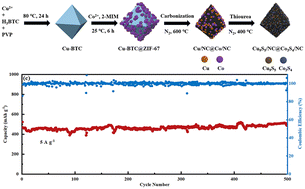
Metal–organic framework (MOF)-derived materials, such as transition metal sulfides (TMSs), are attracting much attention for their high theoretical specific capacity as anodes for lithium-ion batteries (LIBs). Herein, a core–shell-structured anode comprising a Cu9S5 core and a Co3S4 shell embedded in nitrogen-doped carbon (NC) (Cu9S5/NC@Co3S4/NC) has been developed by combining the calcination and sulphuration treatments of the Cu-BTC@ZIF-67 precursor. In this composite, both Cu9S5 and Co3S4 exhibit high electrochemical reaction activities. The sulfides were combined in situ with the porous nitrogen-doped carbon to realize an integrated structure, which efficiently alleviated their aggregation and volume variations during the charging and discharging processes. The good reactivity and structural stability of the Cu9S5/NC@Co3S4/NC anode led to a high capacity (1067.3 mAh g−1 at 0.1 A g−1), even at 5 A g−1. The Cu9S5/NC@Co3S4/NC anode showed negligible capacity degradation and maintained a capacity of 500 mAh g−1 after 500 cycles. This study proposes an effective strategy for engineering high-performance sulfide-based anodes for LIBs, as evidenced by their superior electrochemical performance.
 Please wait while we load your content...


