


Hierarchical Ni-doped Fe7S8/MoS2 heterostructures: enhanced oxygen evolution reaction via electronic redistribution and structural reconstruction
 *a
*a
Abstract
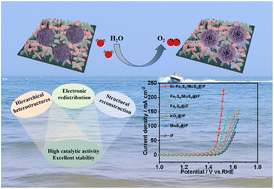
MoS2-based materials are widely studied for their excellent hydrogen evolution reaction (HER) performance. In contrast, their oxygen evolution reaction (OER) performance is relatively poor, typically requiring a higher overpotential to drive the process. This leads to increased energy consumption in water electrolysis. In this work, we develop self-supporting Ni-doped Fe7S8/MoS2 hierarchical heterostructures that can be directly utilized for the OER. Intriguingly, Ni doping induces the growth of uniform nanoflower structures on the nanosheets, a unique morphology that enhances electrolyte–material contact. More importantly, Ni doping can also modulate charge transfer across heterogeneous interfaces and optimize intermediate adsorption. Meanwhile, the selective leaching of Mo during the OER creates a favorable microenvironment, promoting the partial reconstruction of Fe7S8 into FeOOH, which acts as efficient active sites, thereby enhancing the OER performance. As expected, the catalyst exhibits remarkably low overpotentials of 186.1 mV and 287.2 mV to achieve current densities of 10 mA cm−2 and 200 mA cm−2 respectively in 1 M KOH for the OER. Additionally, it demonstrates a low Tafel slope of 59.74 mV dec−1, and retains 84.3% of its initial current density (1000 mA cm−2) after a 220 h chronoamperometry test conducted at 1.669V. This work reveals the beneficial effect of Ni doping on the OER activity of transition metal sulfides, offering novel insights for developing highly efficient and stable electrocatalysts.
 Please wait while we load your content...


