Jakob Jäger, Nadine Tchamba Yimga, Marta Urdanpilleta, Elizabeth von Hauff and Frank Pammer
J. Mater. Chem. C, 2016,4, 2587-2597
DOI:
10.1039/C5TC04251H,
Paper


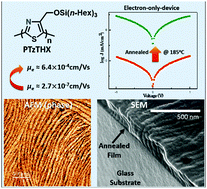
Series of three new highly head-to-tail regioregular poly(4-alkylthiazole)s (PTzTIB, PTzTNB, and PTzTHX) equipped with different trialkylsilyloxymethyl (R3SiOCH2–) side-chains have been prepared (PTzTIB: R = isobutyl, PTzTNB: R = n-butyl, PTzTHX: R = n-hexyl). The polymers exhibit very similar optical and electronic properties, in agreement with the isoelectronic nature of their respective conjugated systems. However, bulk properties, such as (in)solubility, melting behavior and solid-state morphology are strongly affected by the nature of the side-chains. PTzTHX in particular can be readily crystallized through annealing, and exhibits a remarkable tendency to self-organize into crystalline lamellae, that are 50–100 nm wide, and up to 10 μm in length, as demonstrated by investigation of polymer films via GIXD, and AFM and SEM-imaging. Electrical characterization of PTzTNB and PTzTHX in hole-only- and electron-only devices show electron mobilities to be consistently higher than hole mobilities with maximum mobilities of μe = 6.4 × 10⁻⁴ cm2 V−1 s−1 observed for PTzTHX and μe = 2.7 × 10⁻⁴ cm2 V−1 s−1 for PTzTNB. PTzTHX outperforms the less crystalline PTzTNB despite the higher bulk of insulating side-chains. Furthermore, electron-mobilities of PTzTHX are shown to correlate both with the molecular weight and the crystallization after annealing.