



Cubic and tetragonal ferrite crystal structures for copper ion immobilization in an iron-rich ceramic matrix†
Abstract
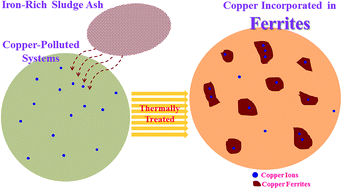
This study proposes a strategy by reusing the incineration ash of municipal wastewater sludge as a ceramic material to immobilize copper. After sintering the mixture of CuO and sludge ash, hematite (α-Fe2O3, one major component) incorporated copper into cubic CuFe2O4. To observe copper incorporation mechanisms, mixtures of CuO + α-Fe2O3 were sintered from 650 to 1050 °C, and different copper incorporation behavior was detected. A low-temperature CuFe2O4 phase with a tetragonal structure was detected at 750 °C, and the cubic CuFe2O4 developed at 1000 °C. The incorporation efficiencies were first quantitatively determined by Rietveld refinement analysis of the X-ray diffraction data. The maximum copper incorporation into tetragonal and cubic CuFe2O4 reached around 80% and 73%, respectively. The leachability analysis pointed to the superiority of both copper ferrites in stabilizing copper, suggesting a promising technique for incorporating copper into the iron-rich ceramic matrix. Both tetragonal and cubic CuFe2O4 were observed with incongruent leaching behavior, but the lower copper concentrations and higher [Cu]/[Fe] ratio in tetragonal CuFe2O4 leachates indicates its higher capacity for copper stabilization. With a high transformation ratio into CuFe2O4 phases and dramatic reduction in metal leachability, the beneficial use of sludge ash to immobilize hazardous metal contaminated soil may be potentially successful.
 Please wait while we load your content...


