


 PLATFORM UPDATE:

Coordination environment design for enhanced catalytic performance of diamond-based nonmetallic and single-atom catalysts
 *a
Hongdong
Li
*a
*a
Hongdong
Li
*a
Abstract
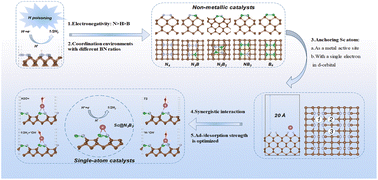
The design of controllable and stable multifunctional electrocatalysts is an important target in renewable energy systems. Herein, we study nonmetallic catalysts, namely, N–B terminated diamond (100) surfaces (N4−xBx, x = 0–4), and single-atom catalysts Sc-doped N–B terminated diamond surfaces (Sc@N4−xBx, x = 0–3), for the hydrogen evolution reaction (HER), oxygen evolution reaction (OER) and oxygen reduction reaction (ORR) using density functional theory (DFT). It is demonstrated that the band gap and electronegativity of the coordination environment are effectively controlled by tuning the B/N ratio in N4−xBx electrocatalysts. Among the series, the N2B2 catalyst exhibits the highest ORR activity. In particular, the Sc@N2B2 catalyst has ΔG*H values of −0.077/0.466 eV under acidic/alkaline conditions and ηOER of 0.790 V, which are attributed to the geometrical symmetry and charge redistribution in the coordination environment. Furthermore, Sc anchoring defines the active-site structure, unifies the rate-determining steps for the OER and ORR, and minimizes their activation barriers. This work establishes a design strategy for enhancing the performance of diamond-based catalysts through coordination-environment engineering.
 Please wait while we load your content...


