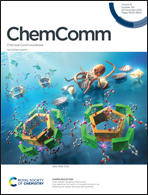
Employing oxalate to protect metal active sites for efficient sulfion oxidation coupled with hydrogen production

Abstract

Catalysts with both high activity and stability are a challenge for the SOR. NiFeC2O4–S requires 0.303 V (vs. RHE) to reach 100 mA cm−2 and operates for 100 h. In the SOR–HER coupling system, it can reach 100 mA cm−2 at 0.542 V and operate stably at 200 mA cm−2 for 100 h. This research provides a new path for sulfion oxidation mixed electrolysis to produce hydrogen.

Graphical abstract: Employing oxalate to protect metal active sites for efficient sulfion oxidation coupled with hydrogen production

Supplementary files

Article information

Article type
Communication
Submitted
23 Sep 2025
Accepted
26 Nov 2025
First published
08 Dec 2025

Chem. Commun., 2026, Advance Article

Employing oxalate to protect metal active sites for efficient sulfion oxidation coupled with hydrogen production

Y. Nie, X. Liu, J. Li, R. Wang and B. Dong, Chem. Commun., 2026, Advance Article , DOI: 10.1039/D5CC05389G

To request permission to reproduce material from this article, please go to the Copyright Clearance Center request page.

If you are an author contributing to an RSC publication, you do not need to request permission provided correct acknowledgement is given.

If you are the author of this article, you do not need to request permission to reproduce figures and diagrams provided correct acknowledgement is given. If you want to reproduce the whole article in a third-party publication (excluding your thesis/dissertation for which permission is not required) please go to the Copyright Clearance Center request page.

Read more about how to correctly acknowledge RSC content.

Social activity

Spotlight

Advertisements