


Glycosyl thiosulfonate-enabled ortho-thiolation via the Catellani strategy: a modular synthesis of polysubstituted aryl thioglycosides

Abstract
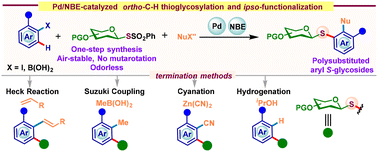
Site-selective introduction of a glycosylthiol group into aromatic compounds is a crucial process in organic chemistry. However, the position at which a glycosylthiol moiety can be introduced is largely restricted to a pre-functionalized site; otherwise, electronically biased substrates or auxiliary groups are needed. Moreover, common ways to stereoselectively prepare aryl thioglycosides often rely on cross-coupling reactions between aryl halides and glycosylthiols. These methods form carbon–sulfur (C–S) bonds at the ipso position of aryl halides; thus, the position of the installed sulfur moiety is restricted by the position of the halide. Switching ipso to ortho thioglycosylation is a formidable challenge. In this study, we introduce for the first time a modular approach involving glycosyl thiosulfonate-enabled ortho-C–H thioglycosylation and ipso-functionalization of aryl iodides/aryl boronic acids via palladium/norbornene cooperative catalysis. Density functional theory (DFT) calculations and experimental studies support that tuning the ancillary ligand in the aryl-NBE palladacycle Pd(IV) intermediate enforces selective reductive elimination, leading to the formation of a C(Ar)–S–Sug bond. The broad substrate scope with good regio- and stereoselectivity makes this dual-task method attractive for the synthesis of poly-substituted arylthioglycosides through a three-component cascade reaction in a single synthetic step. Notable highlights include ipso-alkenylation, hydrogenation, cyanation, and methylation as flexible termination steps and derivatization of poly-substituted arylthioglycosides to obtain various synthetically useful motifs.
 Please wait while we load your content...


