


 PLATFORM UPDATE:


Proton–aromatic ring interactions and their role in enhancing proton affinity of bicycloamines: a DFT study

Abstract
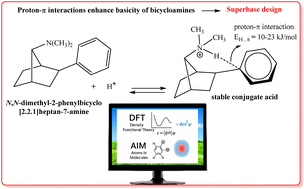
In this study, the role of intramolecular proton–π interactions in enhancing the proton affinity (PA) and gas-phase basicity (GB) of bicycloamine derivatives was systematically investigated using density functional theory (DFT) at the B3LYP-D3/6-311+G(d,p) level. Benchmark calculations confirmed the reliability of this method in describing noncovalent interactions, particularly H+⋯π interactions. The results revealed that the presence of a proximal aromatic ring significantly stabilizes the conjugate acid of bicycloamines through strong proton–π interactions, with calculated interaction energies of 39–117 kJ mol−1 and H+–Cipso distances of ∼2.0–2.3 Å. This stabilization translates into remarkably high PA and GB values, in some cases exceeding the 1000 kJ mol−1 threshold, thereby placing several derivatives in the superbase category. Substituent effects were found to be decisive: electron-donating groups, especially at ortho and para positions, greatly enhanced proton–π interactions and led to the strongest basicity, whereas electron-withdrawing substituents reduced these effects. Atoms-in-molecules analysis confirmed the electrostatic nature of the interaction, while aromaticity indices indicated a consistent reduction in aromatic stabilization upon protonation. Solvent polarity notably modulates the proton–π interaction, with polar protic solvents such as water attenuating the interaction and preserving aromaticity, while nonpolar and the gas-phase conditions enhance the interaction and lead to a greater loss of aromatic character. This work demonstrates that proton–π interactions provide a rational design strategy for engineering new superbases with potential applications in catalysis and materials chemistry.
 Please wait while we load your content...


