


Development of an acute inhalation toxicity testing method based on a lung-on-a-chip
 *ac
*ac
Abstract
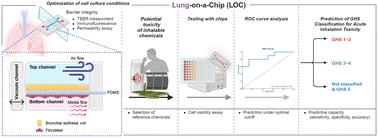
To date, no in vitro test methods for acute inhalation toxicity have been adopted under the OECD Test Guidelines. One major challenge is the difficulty in mimicking the complex physiological and biomechanical environment of the human lung in vitro. Microfluidics can be used to establish extracorporeal lung models with continuous fluid flow and gas exchange. In this study, we aimed to establish the optimal conditions for culturing cells on a lung-on-a-chip (LOC) to identify substances with acute inhalation toxicity. Calu-3 and MRC-5 cells were cultured in the top and bottom channels of the chip, respectively. To evaluate the epithelial barrier integrity, trans-epithelial electrical resistance and permeability were measured every 3 days during air–liquid interface (ALI) culture. When the highest epithelial barrier integrity was reached on day 7 under ALI culture with 2.5% mechanical stretching, acute inhalation toxicity was predicted based on the cell viability of the 18 reference chemicals. The performance was evaluated by receiver operating characteristic curve analysis for predictive capacity in Calu-3 cells. The results of acute inhalation toxicity testing showed a sensitivity of 78%, specificity of 67%, and accuracy of 72% at cutoff values of 12% and 55%. This study demonstrates that the optimized LOC has the potential to serve as a standardized in vitro method for acute inhalation toxicity testing. The integration of microfluidic technology and human-relevant cell models shows promising predictive capacity, suggesting that this LOC system is a practical and ethical alternative to animal testing, warranting further validation.
 Please wait while we load your content...


