


Tuning the MN4 plane in π-conjugated metal-phthalocyanine networks toward efficient CO2 electroreduction: a DFT-ML study
 a
a
Abstract
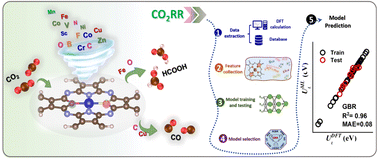
Efficient CO2 electrocatalysts are essential for achieving carbon neutrality, and there is an urgent need to move beyond the current range of metal phthalocyanines (MPcs) by developing next-generation, highly active, and cost-effective electrocatalysts. Herein, a combined density functional theory (DFT) and machine learning (ML) strategy was employed to systematically screen a library of M–N2X2 phthalocyanines (M = Sc–Zn; X = B/C/N/O/F) as single-atom catalysts for CO2RR to CO and HCOOH. DFT calculations reveal that B, C, and O heteroatoms effectively modulate the electronic structure of MN2X2-Pc frameworks, yielding highly active and selective CO2RR catalysts with low limiting potentials (UL<0.76 V), outperforming noble-metal benchmarks (e.g., Au). Notably, CuN2C2-Pc and FeN2O2-Pc achieve record-low UL values of 0.29 V (CO) and 0.28 V (HCOOH), respectively. By employing a gradient boosting regression (GBR) model, a highly accurate predictive model for UL was established, achieving R2 = 0.96 for UL_CO with only three features and R2 = 0.90 for UL_HCOOH with seven features, underscoring the efficiency of feature selection and utilization. This integrated framework enables rapid catalyst screening and provides mechanistic insights, thereby accelerating the rational design of CO2RR electrocatalysts.
 Please wait while we load your content...


