


Self-assembly of binuclear/hexanuclear lanthanide complexes for functional catalysis

Abstract
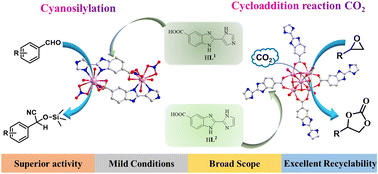
N-heterocyclic carboxylic acid ligands are an important class of ligands in coordination chemistry, which combine the advantages of N and O atoms coordinating with metal centers. In this study, two N-heterocyclic carboxylic acid ligands were synthesized and six complexes were successfully constructed, namely, [La(L1)(NO3)2(H2O)2]2(H2O)2 (1), [Nd(L1)(NO3)2(H2O)2]2(H2O)2 (2), [Sm(L1)(NO3)2(H2O)2]2(H2O)2 (3), [Dy(L1)(NO3)2(H2O)2]2(H2O)2 (4), [Ho6(μ6-O)(μ3-OH)8(L2)4(H2O)16] (5) and [Er6(μ6-O)(μ3-OH)8(L2)4(H2O)16] (6). Among them, HL1 is 2-(1H-imidazole-5-yl)-1H-benzimidazole-5-carboxylic acid and HL2 is 2-(1H-imidazole-2-yl)-1H-benzimidazole-5-carboxylic acid. Structural analysis shows that complexes 1–4 are zero-dimensional binuclear structures, and complexes 5 and 6 form polyhedral erbium clusters through Er–O–Er bridge bonds. Catalytic performance studies demonstrated that complexes 1–6 showed moderate to high yields for the cyanosilylation reaction and the CO2 cycloaddition reaction under mild conditions. Taking complexes 4 and 6 as examples, the influencing factors, substrate universality, catalyst recyclability and possible reaction mechanisms in the catalytic reaction were investigated in detail. Through experimental investigation, the synthesized complexes are expected to become highly promising heterogeneous catalysts for CO2 chemical fixation and cyanosilylation reactions.
 Please wait while we load your content...


