


 PLATFORM UPDATE:


Mechanically robust thermosets featuring room-temperature repairability and chemical upcyclability
 *a
*a
Abstract
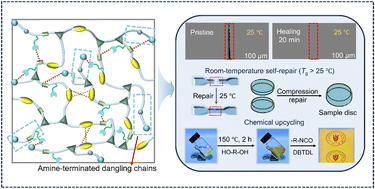
Conventional thermosets cannot self-repair at room temperature due to their immobilized networks and chain segments in the glassy state and are unrecyclable due to permanent cross-links. Herein, we design a new class of room-temperature self-healing thermosets with chemical upcyclability. The incorporation of amine-terminated dangling chains into the cross-linked networks provides two complementary advantages: (i) the terminal amines readily form hydrogen bonds with hydroxyl and ester groups, and due to their high mobility, these hydrogen bonds can reorganize in the glassy state; (ii) the hydrogen-bond network mediated by terminal amines effectively weakens the bond energy of disulfide bonds, thereby facilitating their dynamic exchange under mild pressure at room temperature. 13C NMR of the soluble network fraction together with gel-fraction analysis indicates that tertiary-amine-assisted transesterification may occur to a limited extent under mild pressure at room temperature. Consequently, the cross-linked networks exhibit exceptional room-temperature self-healing capability. Remarkably, the damaged material autonomously restores 86.8% of its tensile strength at room temperature without external intervention and achieves 100% recovery within 30 min under mild pressure. Moreover, end-of-life ETs can be mildly degraded and efficiently chemically upcycled into high-performance poly(urethane-urea) elastomers. This work presents a practical molecular strategy for sustainable thermosets that couple glassy-state self-repair with mechanical robustness and circular-economy compatibility.
 Please wait while we load your content...


