


Sustainable N/S co-doped porous carbon from waste lemon peels for high-performance zinc-ion hybrid supercapacitors
 a
Junqing
Pan
*a
a
Junqing
Pan
*a
Abstract
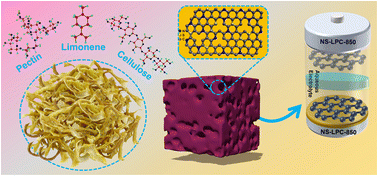
The rising demand for sustainable energy highlights the importance of high-performance energy storage systems, with supercapacitors emerging as a focal point of interest because of their swift charge capabilities and durability. Nonetheless, low energy density, limited charge storage, sluggish ion transport, and interfacial incompatibility hinder their broader application. Herein, we present a cost-effective, eco-friendly approach for synthesizing nitrogen and sulfur co-doped carbon (NS-LPC) from waste lemon peels. The results reveal that N/S co-doping enhances pseudocapacitive behavior by creating redox-active sites that improve charge storage, expanding interlayer spacing to facilitate ion diffusion, and boosting ion transport for faster cycling. The material is synthesized via controlling the carbonization and chemical activation processes. The NS-LPC-850 sample achieves a large specific surface area (2276 m2 g−1) and high capacitance (407 F g−1@1 A g−1). In symmetric supercapacitors, an energy density of 26 Wh kg−1 is observed at 375 W kg−1, whereas a zinc-ion hybrid configuration delivers 370 F g−1 and an impressive energy density of 67.77 Wh kg−1 at 1 kW kg−1. NS-LPC-850 exhibits outstanding cycling stability over 150 000 cycles, outperforming many biomass-derived carbon materials and underscoring the promise of interfacial chemistry for advanced energy storage materials.
 Please wait while we load your content...


