


A Sn/ZnO nano-island hybrid catalyst for neutral H2O2 electrosynthesis from O2 or air

Abstract
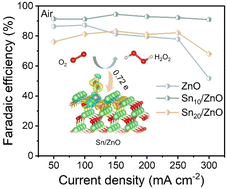
The electrochemical synthesis of hydrogen peroxide via the two-electron oxygen reduction reaction presents a sustainable route for decentralized production, yet it demands catalysts that combine high selectivity with operational robustness under neutral conditions and ambient air. Here we report a rationally designed nano-island hybrid catalyst, comprising atomically dispersed tin species supported on zinc oxide nanosheets, that overcomes the limitations of conventional transition metal-based systems. The optimized Sn10/ZnO catalyst exhibits exceptional performance in neutral media within a flow cell, achieving faradaic efficiencies exceeding 90% and production rates up to 66.10 mol gcat−1 h−1 at 800 mA cm−2 with pure oxygen. Notably, in the same flow cell using ambient air, it sustains 90.9% faradaic efficiency with a production rate of 25.43 mol gcat−1 h−1 at 300 mA cm−2, representing among the efficient performances reported for air-fed systems. Combined experimental analysis and density functional theory calculations reveal that the Sn islands significantly optimize the adsorption energetics of the critical *OOH intermediate, lowering the reaction barrier and promoting the selective two-electron pathway. This work provides fundamental insights into the rational design of main-group element incorporated catalysts for sustainable hydrogen peroxide production.
 Please wait while we load your content...


