Issue 48, 2025

A nanozyme-based colorimetric platform for total antioxidant capacity evaluation: optimizing vine tea brewing with Fe3O4@Ag@Pt

Abstract

Vine tea, a traditional Chinese health beverage derived from Ampelopsis grossedentata, exhibits significant nutritional and medicinal value. Among its numerous bioactive compounds, dihydromyricetin (DMY) stands out as the most prominent constituent. In this study, we developed a colorimetric sensing platform to evaluate the total antioxidant capacity (TAC) of vine tea based on the oxidase-like activity of Fe3O4@Ag@Pt nanocomposites, using DMY as a reference standard. This method exhibited a wide linear detection range, a low detection limit (1 µM), and high accuracy with recovery rates of 97.51–102.1% in real vine tea samples. Furthermore, brewing conditions were optimized. The results revealed that extraction at 90 °C for 15 minutes maximized TAC, whereas repeated brewing (≥2 cycles) significantly reduced the antioxidant content. This study advanced the application of nanozyme-based sensing in food and pharmaceutical analysis, offering a practical approach for evaluating the TAC in flavonoid-rich samples.
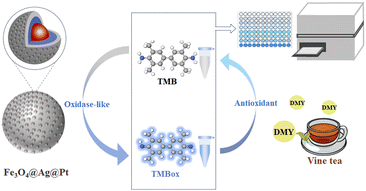
Graphical abstract: A nanozyme-based colorimetric platform for total antioxidant capacity evaluation: optimizing vine tea brewing with Fe3O4@Ag@Pt

Supplementary files

Transparent peer review

To support increased transparency, we offer authors the option to publish the peer review history alongside their article.

View this article’s peer review history

Article information

Article type
Paper
Submitted
19 Sep 2025
Accepted
21 Nov 2025
First published
25 Nov 2025

Anal. Methods, 2025,17, 9799-9805

A nanozyme-based colorimetric platform for total antioxidant capacity evaluation: optimizing vine tea brewing with Fe3O4@Ag@Pt

T. Li, J. Fang, Y. Wang, J. Qu, X. Zhang, X. Qiu and L. Zhang, Anal. Methods, 2025, 17, 9799 DOI: 10.1039/D5AY01574J

To request permission to reproduce material from this article, please go to the Copyright Clearance Center request page.

If you are an author contributing to an RSC publication, you do not need to request permission provided correct acknowledgement is given.

If you are the author of this article, you do not need to request permission to reproduce figures and diagrams provided correct acknowledgement is given. If you want to reproduce the whole article in a third-party publication (excluding your thesis/dissertation for which permission is not required) please go to the Copyright Clearance Center request page.

Read more about how to correctly acknowledge RSC content.

Social activity

Spotlight

Advertisements