


 PLATFORM UPDATE:


Surfactant-mediated mesoscopic confinement and selective interfacial shielding for highly stable zinc anode

Abstract
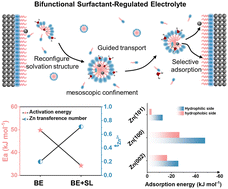
Aqueous zinc-ion batteries are promising for large-scale energy storage due to their safety, low cost, and sustainability. Their practical application, however, is hampered by the instability of the Zn anode, primarily arising from dendritic growth and parasitic side reactions. Here, we report a surfactant-mediated mesoscopic electrolyte utilizing sophorolipid (SL), an amphiphilic surfactant that provides dual behavior. In the bulk electrolyte, SL spontaneously assembles into nanoscale micelles, creating a tailored mesoscopic environment that confines Zn2+ through multivalent dipole interactions. This weakens the solvation shell and enhances Zn2+ transport kinetics. At the same time, unassembled SL molecules selectively anchor onto the Zn surface to form a protective interfacial layer that excludes free water and promotes oriented Zn(101) deposition through electrostatic shielding and spatial confinement effects. This dual regulation mechanism effectively suppresses Zn dendrite formation, hydrogen evolution, and corrosion. Consequently, the resulting electrolyte enables a Zn//Zn symmetric cell to achieve excellent cycling stability for 2800 h at 1 mA cm−2 and 1 mAh cm−2, coupled with a high average coulombic efficiency of 99.3%. Furthermore, assembled Zn//I2 full cells demonstrate outstanding long-term cyclability, retaining nearly 100% capacity after 25 000 cycles at 5 A g−1.
 Please wait while we load your content...


