


Synergistic modulation of desolvation kinetics and Zn2+ flux in a dual-biopolymer interface for stable zinc anodes

Abstract
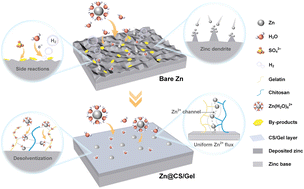
Aqueous zinc ion batteries (AZIBs) have emerged as promising candidates for next-generation large-scale energy storage systems, owing to their safety features and substantial theoretical specific capacity. Nevertheless, their application remains hindered by uncontrollable dendrite growth and side reactions on zinc anodes. In this work, an innovative chitosan/gelatin (CS/Gel) composite polymer gel interfacial layer was engineered through physical cross-linking and facile coating methods. Theoretical calculations revealed that the abundant functional groups in CS/Gel exhibited strong interactions with Zn2+, which promoted rapid desolvation of [Zn(H2O)6]2+ and captured H2O molecules. Additionally, multi-physics field simulations exhibited that the crosslinked networks of Zn@CS/Gel could homogenize the current density distribution and zinc ion concentration distribution on the anode surface, facilitating dense and homogeneous zinc deposition. Importantly, the Zn@CS/Gel symmetric cell provided a stable cycle life of 4400 h at 0.5 mA cm−2. The Zn@CS/Gel‖MnO2 cell could exhibit stable cycle life up to 1000 cycles at 1 A g−1. The rational design of the composite protective layer provides effective guidance for designing robust zinc anodes in AZIBs.
 Please wait while we load your content...


