


Enhanced supercapacitor performance of NiCr–LDH nanosheets supported on exfoliated nano-graphite flakes by a one-step cathode glow discharge electrolysis strategy
 *ab
Jie
Yu,
*a
*ab
Jie
Yu,
*a
Abstract
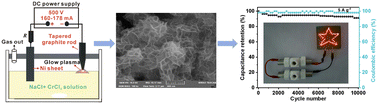
Layered double hydroxides (LDHs) are extensively used as electroactive materials for supercapacitors. However, they exhibit insufficient conductivity, low energy density and poor rate capability. To address the above issues, NiCr–LDH nanosheets supported on exfoliated nano-graphite flakes are used to fabricate flower-like NiCr–LDH/graphite nanocomposites by a simple one-step CGDE strategy. The nanocomposite with a defect structure is assembled from nanosheets with a thickness of 4.8 nm and a specific surface area of 321.7 m2 g−1. The electrochemical performance test revealed that the nanocomposite exhibited a specific capacity of 2577.3 F g−1 and a capacity retention of 86.2% after 10 000 charge–discharge cycles, which are much better than those of pristine NiCr–LDH. A NiCr–LDH/graphite//AC device shows the maximum energy density of 44.37 Wh kg−1 at a power density of 4891.4 W kg−1, with 91.2% retention after 10 000 cycles. The outstanding supercapacitor performances are attributed to the synergistic effect between nano-graphite flakes and NiCr–LDHs, which provided abundant oxygen vacancies, high specific surface area and excellent conductivity for charge transfer and ion diffusion. The CDGE provides a simple, cost-effective, and green synthesis strategy for preparing NiCr–LDH nanosheets supported on exfoliated graphite in a single step.
 Please wait while we load your content...


