Issue 48, 2025

Transplantation of olfactory ensheathing cells embedded in the GelMA-F127DA hydrogel promotes the repair of spinal cord injury

Abstract

Spinal cord injury (SCI) is a highly disabling condition. Olfactory ensheathing cells (OECs) are important transplantable cells for treating spinal cord injury (SCI). However, directly transplanting cells into the injured area may result in the loss of transplanted cells. Additionally, secondary inflammatory responses reduce the survival of transplanted cells. In this study, a hydrogel with favorable properties, including plasticity, strong adhesion, mechanical stability, shear-thinning behavior, and pore size suitable for OEC growth and axon extension, was fabricated from methacryloylated gelatin-pluronic F127 diacrylate (GelMA-F127DA or GEF). In vitro results showed that the GEF hydrogel possessed excellent biocompatibility. Importantly, animal experiments confirmed that transplantation of OECs embedded in the GEF hydrogel effectively repaired SCI, promoted neuronal regeneration and axon remyelination, and improved locomotor function. Accordingly, this treatment strategy offers a new perspective for SCI repair.
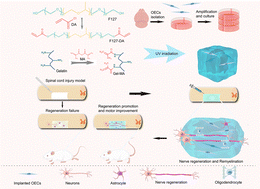
Graphical abstract: Transplantation of olfactory ensheathing cells embedded in the GelMA-F127DA hydrogel promotes the repair of spinal cord injury

Supplementary files

Transparent peer review

To support increased transparency, we offer authors the option to publish the peer review history alongside their article.

View this article’s peer review history

Article information

Article type
Paper
Submitted
21 Jul 2025
Accepted
02 Nov 2025
First published
24 Nov 2025

J. Mater. Chem. B, 2025,13, 15620-15632

Transplantation of olfactory ensheathing cells embedded in the GelMA-F127DA hydrogel promotes the repair of spinal cord injury

Y. Yang, J. Li, J. Zhao, D. Guo, J. Li, J. Li, C. Zhang, C. Zhou, W. Hao, J. Li, S. Ye, S. Chang, G. Yi, H. Zheng, Q. Zhang and X. He, J. Mater. Chem. B, 2025, 13, 15620 DOI: 10.1039/D5TB01678A

To request permission to reproduce material from this article, please go to the Copyright Clearance Center request page.

If you are an author contributing to an RSC publication, you do not need to request permission provided correct acknowledgement is given.

If you are the author of this article, you do not need to request permission to reproduce figures and diagrams provided correct acknowledgement is given. If you want to reproduce the whole article in a third-party publication (excluding your thesis/dissertation for which permission is not required) please go to the Copyright Clearance Center request page.

Read more about how to correctly acknowledge RSC content.

Social activity

Spotlight

Advertisements