


Comprehensive database enables the UHPLC-Q-orbitrap-MS/MS method to discover 16 “overlooked” compounds and supply three new pharmacopoeia quality-markers for charred Semen Arecae (Jiaobinglang)

Abstract
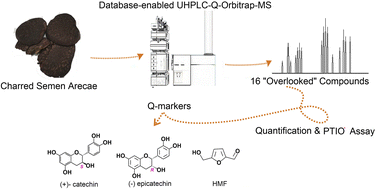
Background: the emerging UHPLC-Q-orbitrap-MS/MS method is not efficient for the deep analysis of charred Chinese herbal medicines (CHMs) due to the lack of a comprehensive database. This study tried to develop a new strategy, i.e., database-affinity ultra-high-performance liquid chromatography-quadrupole-orbitrap-tandem mass spectrometry (UHPLC-Q-orbitrap-MS/MS), to deeply analyze a charred CHM, i.e., charred Semen Arecae (CSA). Methods: database-affinity UHPLC-Q-orbitrap-MS/MS was used to qualitatively and quantitatively analyze the lyophilized aqueous extract of CSA. The relative chemical contents and antioxidant activities of compounds were further evaluated via a PTIO˙ radical scavenging assay. Antioxidant contributions were calculated as “relative antioxidant level × chemical content.” Based on chemical and antioxidant analyses, supplemental Q-markers were proposed and thereafter investigated for their traceability using quantum chemistry. Furthermore, they were validated for applicability using multiple products and analytical technologies (LC-MS and HPLC-UV). Results: thirty-five compounds were putatively identified by database-affinity UHPLC-Q-orbitrap-MS/MS. In particular, 16 “overlooked” compounds were discovered in CSA. Three procyanidin isomers (B1, B2, and B3) were differentiated from each other, and the Maillard reaction intermediate 5-hydroxymethylfurfural (5-HMF) was found to be enriched in CSA. (+)-Catechin and (−)-epicatechin exhibited the highest antioxidant contributions. (+)-Catechin, (−)-epicatechin, and 5-HMF were thus proposed as supplemental Q-markers for CSA. They were evidenced to show good traceability, pharmacology relevance, TCM relevance, testability, and specificity. They were also demonstrated to be applicable for various CSA products from different batches (25 batches in total), locations, extraction methods, and even analytical technologies. Conclusion: sixteen “overlooked” compounds were found in CSA for the first time by database-affinity UHPLC-Q-orbitrap-MS/MS. Three supplemental Q-markers were integrated with arecoline to develop a new pharmacopeia Q-marker system. The system can overcome the limitations of the old and risky Q-marker (arecoline). This successful attempt indicates that a comprehensive database can enable UHPLC-Q-orbitrap-MS/MS for the in-depth analysis of Chinese herbal medicines and quality-control update of charred CHMs.
 Please wait while we load your content...


