


Supramolecular light-harvesting systems enabled by amphiphiles
 b
and
Tangxin
Xiao
*a
b
and
Tangxin
Xiao
*a
Abstract
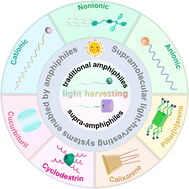
Organizing photoactive components into well-defined nanostructures is a powerful strategy to enhance light harvesting and energy transfer efficiency. Amphiphiles have emerged as unique molecular tools to achieve such organization directly in aqueous media, offering both structural precision and environmental compatibility. In this review, we highlight recent advances in supramolecular light-harvesting (LH) systems enabled by covalent (“traditional”) amphiphiles or supra-amphiphiles. Traditional amphiphile-based systems include cationic, anionic, and neutral amphiphiles: the first two mainly encapsulate donor and acceptor dyes, while neutral amphiphiles often feature donor dyes modified with ethylene glycol chains to self-assemble into LH nanoplatforms. Supra-amphiphiles are primarily constructed via host–guest complexation between water-soluble macrocyclic hosts (e.g., cyclodextrins, cucurbiturils, calixarenes, and pillararenes) and dye-derived guests, leading to organized nanostructures for energy transfer. We discuss the key advantages of these aqueous systems, including enhanced stability, environmentally benign preparation, and facile loading of multiple acceptors for multistep energy transfer. Finally, we provide perspectives on design strategies toward more efficient, stimuli-responsive, and multifunctional supramolecular LH platforms.
 Please wait while we load your content...


