


Constructing a p–n heterojunction between Bi2WO6 and Co3O4 for enhanced photothermocatalytic degradation of toluene
 ab
and
Yuanzhen
Zhou
*ab
ab
and
Yuanzhen
Zhou
*ab
Abstract
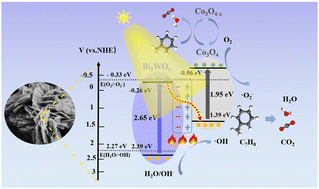
The indiscriminate release of volatile organic compounds (VOCs) has exacerbated environmental pollution. Photothermocatalysis, a low-cost, high-efficiency, and environmentally friendly method, has attracted significant attention for VOC removal. Herein, a series of flower-like Bi2WO6/Co3O4 heterojunction nanocomposites (Bi2WO6/Co3O4 FHNs) were synthesized for photothermocatalytic toluene oxidation. The catalytic activity of Bi2WO6/Co3O4 FHNs is superior to that of the single components Bi2WO6 and Co3O4, with a T90 of toluene at 130 °C under light irradiation. The excellent catalytic activity and stability of Bi2WO6/Co3O4 FHNs are attributable to the distinctive heterojunction interface and the augmented photothermal synergistic effect. The establishment of the p–n heterojunction significantly modifies the electronic structure of the catalyst surface and increases the surface adsorbed oxygen content, which is favourable for the creation of active oxygen. Under light irradiation, the p–n heterojunction can enhance light absorption, charge generation, and light-to-heat conversion capabilities, further boosting the photothermocatalytic degradation performance of toluene. This research provides novel perspectives for exploring and developing high-performance photothermal catalysts for VOC degradation.
 Please wait while we load your content...


