



Electrochromic properties of TiO2 doped with molybdenum ions
 *a
*a
Abstract
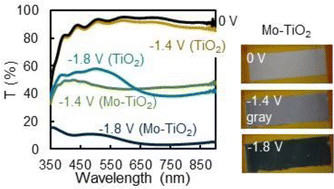
We previously reported a novel photochromism of aqueous Mo6+-doped TiO2 (Mo-TiO2) colloidal solutions, where Mo5+ was formed via the reaction with photogenerated electrons under UV irradiation, resulting in a color change from colorless-transparent to black via gray. However, one drawback of this photochromism was a slow bleaching process. In this study, we investigated the electrochromic properties of Mo-TiO2 to overcome this drawback because the oxidation of Mo5+ to Mo6+ occurs quickly by switching potentials. When the amount of Mo6+ was increased from 1.1 to 5.0 mol%, it took more time to obtain transparent Mo-TiO2 colloidal solutions and 5.0 mol% Mo-TiO2 was found to be the most appropriate amount to fabricate a dip-coating film on fluorine-doped tin oxide glass for electrochromic experiments. In tetrabutylammonium perchlorate/propylene carbonate (PC) electrolytes, electrochromism of the Mo-TiO2 electrode was observed but no coloration occurred on the TiO2 electrode without doping. In LiClO4/PC electrolytes, the coloration of both electrodes remarkably increased at applied potentials (E) less than ca. −1.5 V vs. Ag/AgCl, where the current was controlled by Li+ diffusion. On the TiO2 electrode, no coloration was observed at E ≥ −1.4 V, whereas the Mo-TiO2 electrode exhibited coloration even at −1.0 V, whose transmittance was 72.7 ± 1.5% in the visible region of 400–800 nm. At −1.8 V, the transmittance values of Mo-TiO2 and TiO2 electrodes were 6.7 ± 3.2 and 47.6 ± 7.7%, respectively. These results indicate that the Mo-TiO2 electrode is superior to the TiO2 electrode for electrochromic applications.
 Please wait while we load your content...


