


 PLATFORM UPDATE:


Atomistic insights into hydrogen migration in IGZO from machine-learning interatomic potential: linking atomic diffusion to device performance
 a
Minseok
Moon,
a
Jaehoon
Kim,
a
Eunkyung
Koh,
b
Hyeon-Deuk
Kim,
b
Gyehyun
Park,
b
Seungwu
Han
ac
and
Youngho
Kang
*d
a
Minseok
Moon,
a
Jaehoon
Kim,
a
Eunkyung
Koh,
b
Hyeon-Deuk
Kim,
b
Gyehyun
Park,
b
Seungwu
Han
ac
and
Youngho
Kang
*d
Abstract
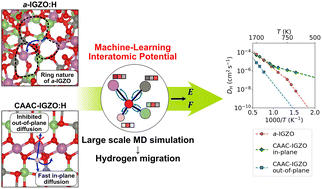
Understanding hydrogen diffusion is critical for improving the reliability and performance of oxide thin-film transistors (TFTs), where hydrogen plays a key role in carrier modulation and bias instability. In this work, we investigate hydrogen diffusion in amorphous IGZO (a-IGZO) and c-axis aligned crystalline IGZO (CAAC-IGZO) using machine-learning interatomic potential molecular dynamics (MLIP-MD) simulations. We construct accurate phase-specific MLIPs by fine-tuning SevenNet-0, a universal pretrained MLIP, and validate the models against a comprehensive dataset covering hydrogen-related configurations and diffusion environments. Hydrogen diffusivity is evaluated over 650–1700 K, revealing enhanced mobility above 750 K in a-IGZO due to the glassy matrix, while diffusion at lower temperatures is constrained by the rigid network. Arrhenius extrapolation of the diffusivity indicates that hydrogen in a-IGZO can reach the channel/insulator interface within 104 seconds at 300–400 K, likely contributing to negative bias stress-induced device degradation. Trajectory analysis reveals that long-range diffusion in a-IGZO is enabled by a combination of hydrogen hopping and flipping mechanisms. In CAAC-IGZO, hydrogen exhibits high in-plane diffusivity but severely restricted out-of-plane transport due to a high energy barrier along the c-axis. This limited vertical diffusion in CAAC-IGZO suggests minimal impact on bias instability. This work bridges the atomic-level hydrogen transport mechanism and device-level performance in oxide TFTs by leveraging large-scale MLIP-MD simulations.
 Please wait while we load your content...


