


 PLATFORM UPDATE:


Ultra-efficient energy transfer and near-infrared luminescence in hexagonal aluminate phosphors enabled by heterogeneous ion pair co-doping

Abstract
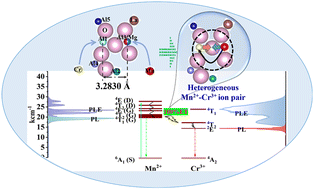
Near-infrared phosphor-converted light-emitting diodes have significant applications in biomedical imaging, night vision technology, industrial inspection, and spectral analysis. Application of typical phosphors, comprising isolated Cr3+ ions and homogeneous Cr3+–Cr3+ ion pairs, represent the predominant strategy for facilitating efficient NIR emission. Nonetheless, this methodology requires extensive doping of Cr3+, leading to luminescence quenching and significant lattice distortion. Here, a heterogeneous ion pair (Mn2+–Cr3+) co-doping strategy was proposed to achieve an ultra-efficient energy transfer from Mn2+ to Cr3+ and boost the NIR emission in trace Cr3+-doped hexagonal aluminate phosphor LaMgAl11O19:Cr3+. The formation of Mn2+–Cr3+ heterogeneous ion pairs was predicted through in-depth structural and theoretical calculations and experimentally demonstrated by electron paramagnetic resonance spectroscopy, X-ray photoelectron spectroscopy, and photoluminescence analysis. Notably, the Mn2+–Cr3+ heterogeneous ion pairs in LaMgAl11O19 could realize an ultimate energy transfer efficiency of 100%, resulting in a record NIR quantum efficiency (IQE ∼100%) upon trace Cr3+ (0.5 mol%) doping. A high output power (134 mW@350 mA) NIR pc-LED and a high color rendering full-spectrum pc-LED (CRI = 90.0) are simultaneously realized based on LaMgAl11O19:Mn2+,Cr3+. This novel perspective on the heterogeneous ion pair offers an enriched understanding of the underlying design principles and facilitates the exploration of innovative NIR emitting phosphors.
 Please wait while we load your content...


