


Transition metal-free organocatalyzed direct N-benzylation of amides via a hydrogen borrowing strategy
 *a
*a
Abstract
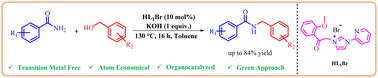
The development of a versatile methodology for the N-benzylation of amides is challenging due to the relatively poor nucleophilicity of the amide nitrogen. Herein, we report the first transition metal-free, broad catalytic methodology for the N-benzylation of amides using alcohols via a hydrogen borrowing methodology. The crucial step is the oxidation of the benzyl alcohol by the in situ generated N-heterocyclic carbene (NHC) to form 3-(2-(2-methoxyphenyl)-2-oxoethyl)-1-(pyridin-2-yl)-1H-imidazol-3-ium bromide (HL1Br). The carbene-based organocatalyst (HL1Br) efficiently sequesters hydrogen (as 2H+ + 2e−) produced during the dehydrogenation of the alcohol via a single-electron transfer (SET) process and returns the same to the in situ generated imine intermediate to yield the final N-benzylated product. The developed protocol is also applied for N-benzylation of aniline and selective mono-benzylation of benzene-1,2-diamine to form N1-benzylbenzene-1,2-diamine. Control experiments, available literature, and HRMS characterization support the plausible mechanism.
 Please wait while we load your content...


