


PbI2 interface reconstruction suppresses ion migration for stable planar perovskite solar cells
 *abc
*abc
Abstract
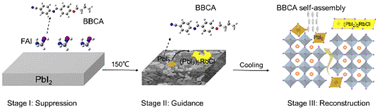
Excess PbI2 is widely recognized as a critical factor in enhancing the efficiency of perovskite solar cells, yet the random aggregated PbI2 undergoes photodecomposition, and the migration of I− remains a critical bottleneck for long-term device operation. Herein, we report a PbI2 multi-interface reconstruction strategy enabled by the thermotropic liquid crystal molecule of 4-butoxybenzylidene-4-cyanoaniline (BBCA). During annealing, the dynamic phase transition of BBCA, along with its oriented arrangement and ordered self-assembled stacking, drives the formation of the (PbI2)2RbCl secondary phase and redistributes PbI2 from the buried interface and grain boundaries to the upper surface. This process realizes synergistic PbI2 reconstruction across multi-interfaces, effectively suppressing light- and heat-induced side reactions. Moreover, BBCA reduces defect density and non-radiative recombination losses, and optimizes the energy barrier, enhancing the PCE from 22.85% to 25.14%. Additionally, BBCA acts as a stabilizer by inhibiting both I− oxidation and migration under operation, thereby enhancing device stability. This work introduces a novel strategy for controlling PbI2 content and distribution across multi-interfaces while simultaneously suppressing ion migration, enabling highly efficient and stable perovskite solar cells.
 Please wait while we load your content...


