


The characteristic impact of a hydrophobic medical gauze modified with lauric acid–ZnO and its antimicrobial behavior and wound healing properties
 *b
*b
Abstract
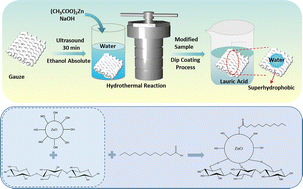
Wound care has garnered significant attention due to the limitations of current dressings, which often exhibit suboptimal clinical efficacy. There is an urgent need to develop advanced multifunctional materials with high mechanical strength, blood repellency, antibacterial properties, and anti-adhesion capabilities for improved wound management. In this study, we developed a novel hydrophobic gauze, termed LA–ZnO/MG, by synthesizing zinc oxide (ZnO) in situ on medical gauze (MG) utilizing a hydrothermal method and subsequently modifying the surface with lauric acid (LA) via an impregnation technique. LA–ZnO/MG can maintain good mechanical stability, water repellency and durability in the tests of sandpaper wear, tape stripping, self-cleaning, knife scratching and heat treatment. Furthermore, LA–ZnO/MG showed good permeability and biocompatibility. LA–ZnO/MG-2 exhibited significant antibacterial activity against methicillin-resistant Staphylococcus aureus (MRSA) and Escherichia coli (E. coli); the hydrophobicity of LA–ZnO/MG, coupled with the release of Zn2+ ions, plays a significant role in preventing bacterial adhesion and inhibiting bacterial growth. LA–ZnO/MG-2 also successfully reduced blood loss with low stripping force and exhibited excellent blood repellency, as confirmed by in vitro and in vivo hemostasis assays. In the dorsal wound model test with mice, LA–ZnO/MG-2 showed bacteriostatic and anti-adhesion effects that enhanced the rate of wound healing compared to the control group treated with MG alone. By the 14th day, the wounds in the LA–ZnO/MG-2 group had nearly healed, with a healing rate of approximately 95.2 ± 0.8%. LA–ZnO/MG presents a simplified approach for developing new dressings and shows promising potential for application in wound dressings.
 Please wait while we load your content...


