


Biomimetic hierarchical scattering coatings via interfacial molecular stitching for durable radiative cooling of outdoor power facilities
 *a
*a
Abstract
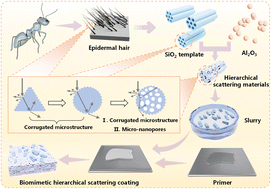
Radiative cooling offers a passive pathway to reduce the substantial carbon emissions associated with the thermal management of outdoor power infrastructure. However, its deployment is thwarted by an intractable trade-off between optical performance and weatherability. Inspired by the hierarchical light-scattering structure of silver ant hairs (SAHs), we report a durable biomimetic radiative cooling coating based on a hierarchical scattering material (HSM) with randomly distributed nanopores and resonance-enhanced molecular groups. Unlike prior efforts to replicate the cross-sectional geometry of SAHs, our design leverages their single-hair scattering mechanisms and molecular vibrational modes, which enables the coating to achieve 97% solar reflectance and 0.96 sky-window emittance. Through interfacial molecular stitching, the HSM-coating exhibits strong substrate adhesion and environmental resilience. Over 24 days of testing, the coating achieved a 15.4 °C surface temperature reduction on a power facility during daytime operations. This combination of biomimetic optical engineering and robust interfacial bonding renders the coating with facile fabrication, robust substrate adhesion, chromatic scalability, and resistance to extreme thermal cycling, ultraviolet, acid rain, dust, and particulate abrasion. Our work validates a viable strategy to achieve all-weather durable radiative cooling of outdoor power facilities, offering a tangible solution for reducing the carbon emissions from urban thermal management.
 Please wait while we load your content...


