


Bridging the thermal expansion gap in solid oxide fuel cells: towards robust and efficient energy conversion

Abstract
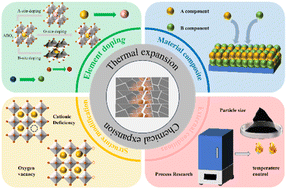
Solid oxide fuel cells (SOFCs) have emerged as a promising electrochemical technology for the direct and highly efficient conversion of chemical energy into electricity, offering an all-solid-state architecture with minimal environmental impact. However, the inherent thermal expansion mismatch among SOFC components remains a critical bottleneck, leading to structural degradation, delamination, and mechanical failure—major impediments to long-term operational stability and commercial deployment. Addressing this challenge necessitates the precise design and engineering of materials with tailored thermal expansion behavior to ensure seamless integration across all functional layers. This review provides a comprehensive examination of the fundamental mechanisms governing thermal expansion in SOFC materials, explores state-of-the-art strategies to enhance thermal expansion compatibility, and critically discusses emerging approaches for fine-tuning thermal expansion coefficients. By identifying key challenges and future research directions, we aim to provide a roadmap toward the development of mechanically robust, thermally stable SOFCs, thereby advancing their practical realization in sustainable energy applications.
- This article is part of the themed collection: Journal of Materials Chemistry A Recent Review Articles
 Please wait while we load your content...


