


A PVP-assisted Fenton approach for MWCNT purification and its application in conductive hydrogel fabrication
 *a
and
Zhi shan
Bai
a
*a
and
Zhi shan
Bai
a
Abstract
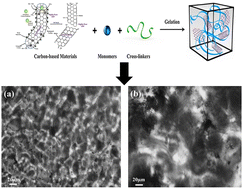
Impurities such as residual metal catalysts and amorphous carbon in pristine multi-walled carbon nanotubes (MWCNTs) hinder their dispersibility and conductivity in aqueous media, thereby limiting their application in conductive hydrogels. Here, we report a polyvinylpyrrolidone (PVP)-assisted Fenton method for efficient removal of impurities, and systematically investigate the influence of PVP doping on surface characteristics and dispersion stability in water. Optimal purification, achieved with 10 wt% PVP, establishes a stable non-covalent coating that effectively eliminates impurities and markedly improves aqueous dispersibility. Incorporating 0.3 wt% of these purified MWCNTs into a polyacrylamide-poly(2-acrylamido-2-methylpropanesulfonic acid)/poly(3,4-ethylenedioxythiophene)/poly(styrenesulfonate) conductive hydrogel matrix yields a material with significantly enhanced performance: tensile strength (151.81 kPa), elongation at break (1595%), toughness (1.73 MJ m−3), and compressive strength (254.3 kPa) are increased by 11.58% compared to pristine MWCNT-containing hydrogels, while the electrical conductivity reaches 2.85 S m−1, representing a 13% improvement. This PVP-assisted Fenton purification strategy substantially enhances the functional performance of MWCNTs, enabling the development of high-performance conductive hydrogels with strong potential for flexible strain-sensing applications.
 Please wait while we load your content...


