


Polarity-enhanced cationic π-conjugation in Mn(ii)-based metal halide luminescent materials: boosting quantum yield and enabling anti-counterfeiting

Abstract
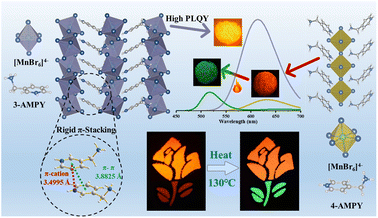
Low-dimensional lead-free Mn(II)-based organic–inorganic metal halides (OIMHs) are promising luminescent materials, yet molecular-level fine-tuning of organic structures to achieve high quantum yield and functional red-light emission remains challenging. In this study, three Mn(II)-based OIMHs were designed and synthesized using aminomethyl-pyridine isomers as cations. The results show that when 3-(aminomethyl)pyridine (3-AMPY) is employed as the organic ligand, its π-conjugated framework and enhanced molecular polarity facilitate the formation of a highly ordered and rigid zero-dimensional octahedral hybrid architecture, which achieves a high photoluminescence quantum yield (PLQY) of 63.42% with bright orange-red emission at 614 nm. In contrast, 2-AMPY and 4-AMPY counterparts only demonstrate weak red emission with low PLQY of 14.05% and 9.23%, respectively. Notably, (4-AMPY)4Mn3Br15 exhibits sensitive and irreversible red-to-green emission switching upon thermal treatment due to phase transition. To leverage this thermoresponsive luminescence behavior, a heating-assisted digital encryption system has been developed for complex information. This work reveals how cation substitution regulates the OIMH structure–property relationship and enriches the family of lead-free metal halides for anti-counterfeiting, information security, and optoelectronic applications.
 Please wait while we load your content...


