


Advancements and challenges in metal selenides for electrocatalytic H2 evolution
 *ab
*ab
Abstract
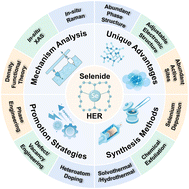
Metal selenides (MSes) have emerged as promising electrocatalysts for hydrogen evolution reaction (HER) due to their abundant reserves, tunable electronic structures, diverse phase compositions, and favorable electrical conductivity. However, the electrocatalytic performance of MSes is still constrained by inherent limitations such as insufficient active sites and sluggish reaction kinetics. This review focuses on the applications of MSe-based HER electrocatalysts. Herein, the unique structures and electronic properties of MSes are first highlighted. Subsequently, the fabrication approaches and performance modulation strategies of the MSe-based electrocatalysts are explicated systematically. Thereafter, the electrocatalytic mechanism of MSes is elucidated using both in situ characterization and theoretical calculations. Finally, the future perspectives and insightful development directions for the rational design and practical application of high-performance MSe electrocatalysts are proposed. This review aims to offer in-depth insights and targeted guidance for developing highly active MSe-based catalysts.
- This article is part of the themed collections: Journal of Materials Chemistry A Recent Review Articles and Journal of Materials Chemistry A HOT Papers
 Please wait while we load your content...


